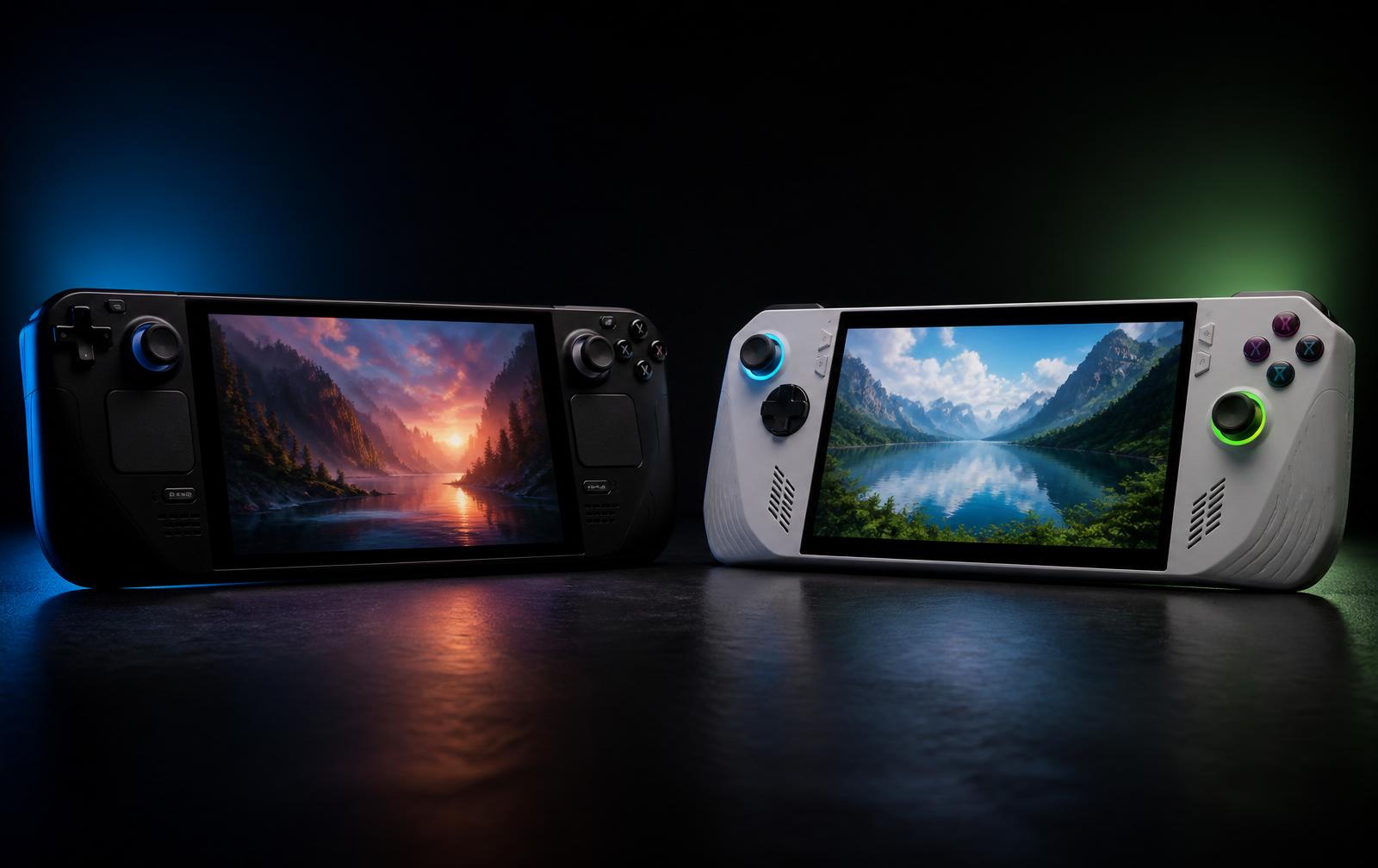
Steam Deck OLED vs ROG Ally X: The 2026 Verdict
Two years into the current handheld generation, Valve's Steam Deck OLED and ASUS' ROG Ally X have settled into distinct roles. This editorial comparison uses official specifications, warranty coverage and expert consensus — not in-house benchmarks — to help you choose.
Affiliate disclosure. This page contains affiliate links. As an Amazon Associate, PixelLoadout may earn a commission from qualifying purchases at no additional cost to you. Commissions never influence our editorial recommendations.
- Independent editorial
- Research driven
- Evidence based
- Regularly updated
- Editorial standards
- Affiliate transparency
Quick Verdict
Both handhelds are excellent in 2026, but they solve different problems. The Steam Deck OLED is the more refined, better-priced, better-screened Linux console — a genuine 'sit down and play' device. The ROG Ally X is the more powerful, more flexible Windows PC in a handheld shell — better for demanding new releases, Game Pass, and users who want a portable PC first, a console second.
Feature comparison
| Spec | Steam Deck OLED (1TB) | ROG Ally X |
|---|---|---|
| Launch price (MSRP) | $649 | $799 |
| APU | AMD Sephiroth (Zen 2 / RDNA 2) | AMD Ryzen Z1 Extreme (Zen 4 / RDNA 3) |
| RAM | 16 GB LPDDR5-6400 | 24 GB LPDDR5X-7500 |
| Internal storage | 1 TB NVMe | 1 TB NVMe (M.2 2280) |
| Display | 7.4" HDR OLED, 90 Hz, 1000 nits peak | 7" IPS LCD, 120 Hz, 500 nits |
| Battery | 50 Wh | 80 Wh |
| Weight | ~640 g | ~678 g |
| OS | SteamOS 3 (Linux) | Windows 11 |
| Game Pass / Xbox app | Workarounds only | Native |
| Warranty (US) | 1 year | 1 year |
OLED vs high-refresh IPS
The Steam Deck OLED's HDR panel is the most-praised change in the current handheld generation. Per Valve's official specifications, it hits 1000 nits peak in HDR content, runs at 90 Hz, and covers the DCI-P3 gamut — a combination widely reported by independent reviewers to deliver noticeably deeper blacks and richer color than any LCD handheld on sale today.
The ROG Ally X counters with a 120 Hz IPS panel that hits 500 nits (ASUS spec). It is smoother in motion — a real advantage in fast-paced esports titles — but cannot match OLED contrast, black levels or HDR performance. For most players, the OLED's image quality edge outweighs the Ally X's refresh-rate advantage.
Raw power and real-world play
The Ally X's Ryzen Z1 Extreme (Zen 4 / RDNA 3) is a full architectural generation ahead of the Steam Deck's custom Zen 2 / RDNA 2 APU. Third-party technical outlets consistently report the Ally X running demanding 2024–2025 releases at higher frame rates and higher graphics presets, particularly at 25 W turbo.
The Steam Deck OLED targets a lower, more consistent power envelope (typically 4–15 W) and pairs it with SteamOS' aggressive per-game tuning. For the vast library of indie, older AAA and mid-tier games most handheld owners actually play, the Deck is remarkably competitive — often at half the fan noise and with substantially longer battery life per watt.
Runtime in the real world
The Ally X's 80 Wh battery is the largest in class and roughly double the original Ally's. Reviewers report 2–4 hours in demanding titles and 5–7+ hours in lighter games. The Steam Deck OLED's 50 Wh pack, combined with the more efficient OLED panel and lower-power APU, delivers a broadly similar range (3–8 hours) despite being physically smaller — an efficiency win for Valve.
SteamOS vs Windows 11
SteamOS is the single biggest reason the Steam Deck feels like a console: sleep and resume works reliably, per-game TDP is one tap away, and the UI is designed for a controller. Non-Steam launchers (Epic, GOG, EA) run via community tooling but are not first-class.
Windows 11 on the Ally X is more capable and more compatible — Game Pass, Xbox cloud, every PC launcher, mod tools, emulators — but it is also more fiddly. Sleep and driver behavior have improved substantially since launch, but the Deck still wins on out-of-box polish.
Pros
- Steam Deck OLED — best-in-class HDR OLED display
- Steam Deck OLED — $150 cheaper at MSRP
- Steam Deck OLED — the most polished handheld software experience
Cons
- ROG Ally X — significantly more raw performance
- ROG Ally X — 24 GB RAM and 80 Wh battery lead the class
- ROG Ally X — native Windows: Game Pass, every launcher, full PC compatibility
Category winners
HDR OLED at 1000 nits peak — the clear image-quality leader in the category.
Zen 4 / RDNA 3 with 24 GB RAM outpaces the Deck's Zen 2 / RDNA 2 in demanding titles.
Comparable runtimes from a 50 Wh pack vs. the Ally X's 80 Wh — a real efficiency lead.
SteamOS' sleep, resume and per-game TDP remain the smoothest handheld UX in 2026.
Native Game Pass, Xbox app, and every PC launcher — no workarounds required.
$150 cheaper at MSRP for the 1 TB model, with the better screen.
Steam Deck OLED — for most gamers.
For the majority of buyers, the Steam Deck OLED is the better handheld: a class-leading screen, the most refined software, and a $150 lower price. Choose the ROG Ally X when you specifically need Windows, Game Pass, or maximum performance in the newest AAA releases — it is the more powerful device, but also the pricier and less polished one.
Frequently Asked Questions
Final Verdict
If we could only buy one handheld today, we'd pick the Steam Deck OLED. It is $150 cheaper, has the best screen in the category, and offers the most polished handheld software experience in 2026. Buy the ROG Ally X only if you specifically need Windows, Game Pass, or maximum performance in the newest AAA releases.